
Almost every grey cat in Australia gets called a Russian Blue at some point. Most are not. This is not a snobbish distinction – it affects what you should pay, what temperament to expect, and whether the seller is being honest with you.
Quick answer: Russian blue vs grey cat — here’s the short version. Always verify registration and meet the kitten (or video call) before paying — our Russian Blue kittens for sale come with full health records.
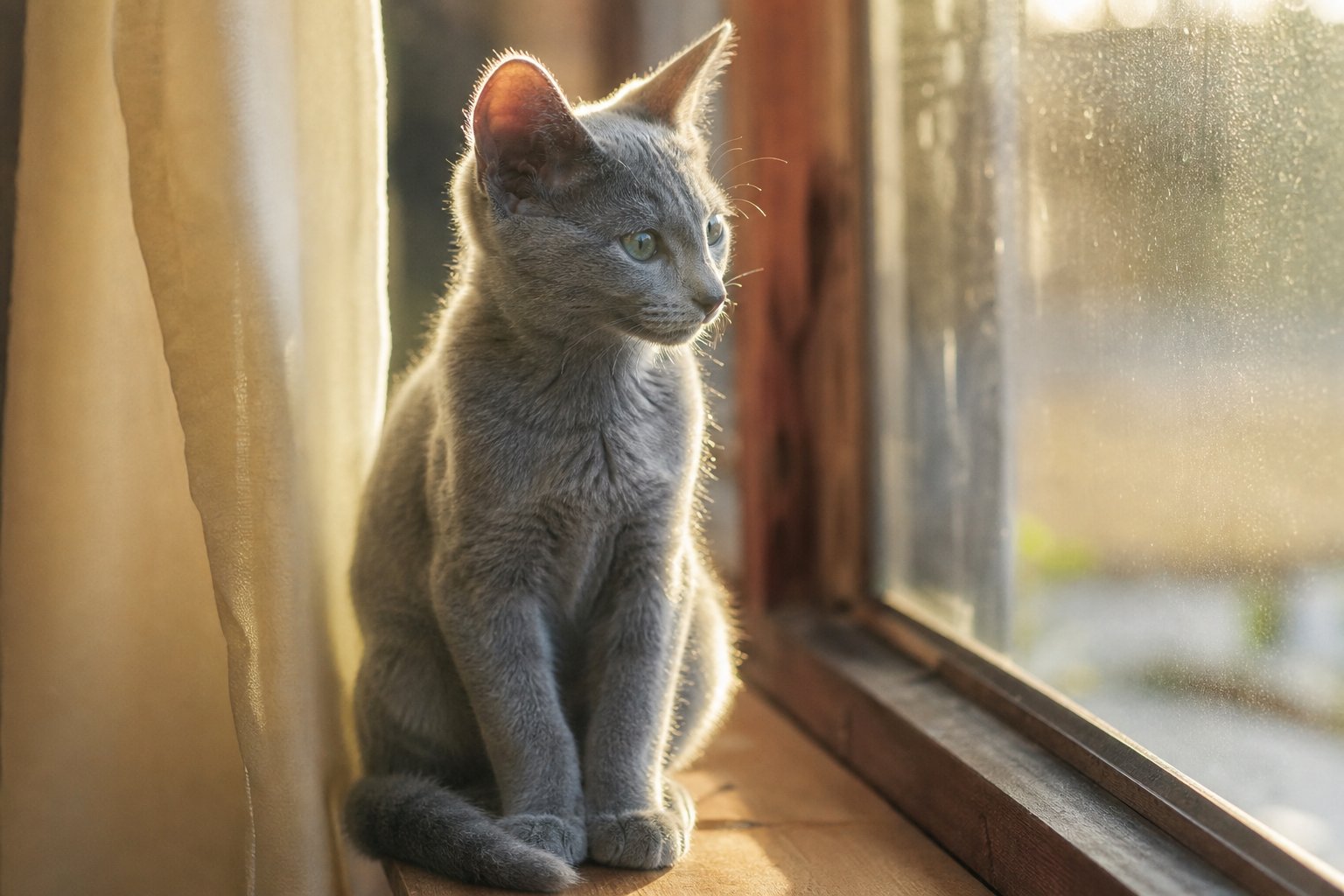
The differences at a glance
| Feature | Russian Blue | Grey domestic shorthair |
|---|---|---|
| Coat | Short, dense double coat with silver tipping; stands away from the body | Single coat, lies flat, no silver sheen; texture varies |
| Colour | Even blue-grey throughout, no markings in adults | Grey with frequent tabby ghosting, often white patches |
| White markings | None – a fault in the breed standard | Common: bib, chest, paws, locket, tail tip |
| Eyes (adult) | Vivid clear green, almond-shaped, wide-set | Green, gold, copper or yellow; usually rounder |
| Eyes (kitten) | Born blue, amber by 4 months, green by about 2 years | Variable, usually settles to adult colour earlier |
| Head | Modified wedge, flat skull, straight profile | Rounded or variable |
| Ears | Large, wide-based, pointed | Proportionally smaller |
| Build | Fine-boned, muscular, long and elegant | Variable, often stockier |
| Paw pads | Mauve-pink to lavender | Grey, dark or mottled |
| Nose | Slate grey / charcoal | Black, grey or variable |
| Temperament | Reserved, devoted, quiet, bonds strongly to one or two people | Entirely individual – no breed predictability |
| Documentation | Pedigree certificate, registered parents | None |
| Typical Australian price | $1,500 – $2,500 | $0 – $400, or included in a rescue adoption fee |
The three quickest filters
1. White anywhere
If there is a white bib, white paws, a white chest patch or a white tail tip, it is not a pedigree Russian Blue. White markings are a disqualifying fault in the breed standard. This single check eliminates a large proportion of “Russian Blue” listings.
2. Paw pad colour
Mauve-pink to lavender pads are characteristic. Dark grey, black or mottled pads indicate other breeds in the ancestry. Ask for a photo of the pads – most sellers will not think to provide one, which itself is informative.
3. Coat behaviour
Stroke the coat backwards. On a Russian Blue it parts and springs back, and you can see the silver tips catching light. On a domestic grey it simply lies flat and looks uniformly matte grey.
Temperament: the honest caveat
Breed temperament is a tendency, not a guarantee, and this is where the comparison gets nuanced. Russian Blues are reliably reserved, quiet, devoted and often one-person cats. That predictability is a genuine product of deliberate breeding and is worth paying for if those traits are what you want.
A grey domestic shorthair has no breed predictability at all. It might be exactly like a Russian Blue in temperament, or utterly different. What you can assess instead is the individual animal and its history: how it was raised, how it responds when handled, and what the carer tells you about its behaviour.
Russian Blue temperament: what living with one is really like covers the breed tendencies in detail.
When a grey moggy is the better choice
Be straight about this – there are strong arguments for the domestic option:
- Cost. A rescue adoption in Australia typically runs $150 to $350 and includes desexing, vaccination, microchip, worming and a vet check. That is $1,200 to $2,200 less than a pedigree kitten, with the same core vet work done.
- Genetic diversity. Mixed-ancestry cats generally have broader gene pools and fewer inherited conditions than purebreds.
- You see the adult cat. Adopting an adult means you know the personality you are getting, rather than forecasting from a kitten.
- You free a shelter space. Australian shelters are consistently full.
- Health. Grey domestic shorthairs are typically robust, low-maintenance cats with no breed-specific concerns.
Adopting versus buying from a breeder compares the two routes properly, and why an adult is a smart choice makes the case for skipping kittenhood.
When a pedigree Russian Blue is worth it
- You specifically want the breed temperament. Predictable reserve, quietness, strong bonding and low drama. If you are choosing this breed after research, that predictability is the product.
- You want a kitten and want to shape its upbringing. A good cattery socialises from birth and you know exactly what the kitten has experienced.
- You want documented health background. Parent health testing, and a health guarantee in the contract.
- You want breeder support for fifteen years. A registered breeder remains a resource for the cat’s life, and typically requires the cat be returned to them if you cannot keep it – a genuine safety net.
- You care about the breed. Supporting ethical breeders is how the breed’s health and type are maintained.
Is a Russian Blue worth it? sets out the full honest case, and what a $2,500 kitten pays for explains the price.
What to do if a listing says “Russian Blue” but is not
Most sellers are not deliberately lying. Many genuinely believe their grey cat is a Russian Blue because someone told them so, or because “Russian Blue cross” has been repeated down the generations until the cross disappeared from the description.
- Ask, politely, what registry the parents are registered with. An honest seller will say “they are not”.
- If the answer is vague or the price is pedigree-level for an unverified cat, walk away. Listing red flags.
- If you like the cat anyway, negotiate to a domestic price. Many sellers accept this readily once the paperwork question is raised.
- Never pay a pedigree price without pedigree documents. How to verify.
The fair summary
A grey domestic shorthair is a wonderful cat and a genuine bargain. A pedigree Russian Blue is a different purchase – you are buying predictability of temperament, documented health background, and breeder support, and that is what the price reflects.
Quick answers
How do I know if my grey cat is a Russian Blue?
Without pedigree papers you cannot be certain. Physical clues are silver-tipped dense double coat, no white markings, mauve-pink paw pads, slate nose, wedge head and vivid green adult eyes.
Are Russian Blue crosses common in Australia?
Very. Many cats described as Russian Blue crosses are simply grey domestic shorthairs, since the breed name has been repeated down the generations without documentation.
Is a grey domestic cat healthier than a pedigree Russian Blue?
Generally mixed-ancestry cats have broader gene pools and fewer inherited conditions. Russian Blues are nonetheless a robust breed with few breed-specific problems.
Should I pay pedigree prices for an unverified grey kitten?
No. Pay a pedigree price only for documented pedigree. An unverified kitten should be priced as a domestic or rescue animal.
Related reading
Russian Blue vs Grey Cat: FAQs
How much does it cost to act on this?
When readers ask about russian blue vs grey cat, the budget question comes first: our Russian Blue kittens are $2,500 with a $250 deposit, vet-checked and fully documented — see current Russian Blue kittens for sale.
Should I visit the cattery?
Yes — russian blue vs grey cat always goes better when you see where kittens are raised. If distance prevents a visit, insist on a live video call; see what a good cattery visit looks like.
What should I do next about russian blue vs grey cat?
Read our 99 kitten-buying FAQs, then enquire — we reply within 24 hours and will happily talk through russian blue vs grey cat for your situation.
Independent guidance: Verify pedigree and registration standards through TICA, The International Cat Association before you pay a deposit.
Ready to meet your kitten?
Our Russian Blue kittens are raised in our family home, vet-checked, vaccinated, microchipped, wormed and socialised before they travel. We reserve with a $250 deposit and deliver Australia-wide.